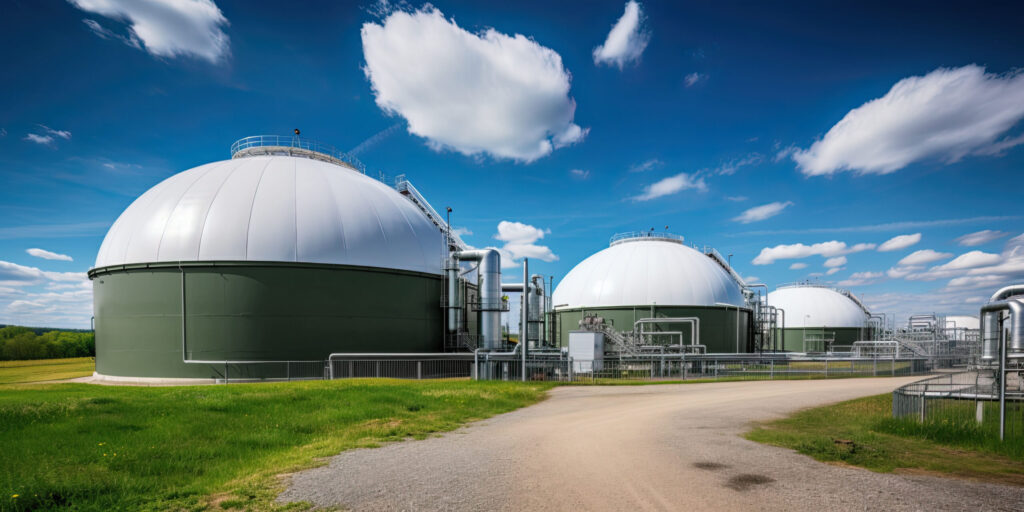
Site B is a farm-based AD plant using ensiled maize, cattle manure and sugar beet pulp on a seasonal basis. The site has 2 primary tanks in parallel with a total volume of 9600m3. It is a 5MWth biomethane plant with a gas to grid cap of 500m3/hr.
The site regularly reaches its cap and would like to reduce expensive feedstocks.
This is a well-run site with comprehensive data recording and analysis. The is an experienced company with a strong understanding of anaerobic digestion and concern for the environment.
Our Approach
We run our large-scale operations, following a proven process to maximise the outputs and collect data relevant for performance monitoring. We require minimum input from the operator at the same time offering our expert advice to add further value.
The Carbogenics team assess the sites operational and chemical data filling in any gaps where necessary.
CreChar is supplied in 25 kg digestible bags which are added to the solid feed hopper daily, resulting in no disruption to normal plant operation.
Results
The green bars show the monthly average methane yield per tonne of dry matter from the whole site. The Black line is the CreChar® concentration in tank One. The trial was split into 2 parts with a one-month gap. This is shown by drop in CreChar® concentration in May. In addition, a temperature increases in July led stressed microbiology and underperformance.
Despite fluctuations the analysis shows that there was a 4% reduction in expensive feedstock.
1% increase in methane concentration.
The analysis also shows a reduction of 5% in ammonia concentration compared to tank Two.
The operator reported a period of stable plant operation. This indicates a stable and efficient microbiology allowing for smooth performance.
PAS 110 analysis has also shown that CreChar has no negative impact on digestate quality for application to land. 57t of Co2e were removed via CreChar sequestration in the soil through digestate.
Benefits
Reduced feedstock costs and methane concentration will help plant achieve annual savings of £137k/y that can be increased up to £274k/y by increased dose to treat both tanks.
Reduction in ammonia concentration will stabilise the microbiology and reduce toxicity to allow for the use of higher ammonia feedstocks such as chicken manure to realise further saving.
Regular use of CreChar® can also help stabilise the AD plant biology to enhance its performance and minimise expensive troubleshooting.
Get a tailored CreChar® solution
Tell us about your application and we’ll provide a data-driven quote based on your specific requirements.
For further information on Crechar® and other services from Carbogenics please contact:
Site F operates a 4500m3 two stage semi-plug flow digester with a 1500m3 primary and 3000m3 secondary. The customer processes biogas via CHP engines into electricity with a capacity of 2 MW across 2 locations.
Site E is a CHP site which operates a Marches Biogas Double Ring digester on a mix of feedstocks, including Potato Peelings, Potatoes, Vegetable Waste, Chicken Manure, and Liquid Sugar.
We use cookies to ensure that we give you the best experience on our website. If you continue to use this site we will assume that you are happy with it.